



Home » Directory of Dye Plants
Before you begin, it’s important to know what a dye plant is.
All plants can produce colour, but only some are truly considered dye plants.
These are plants whose certain parts (roots, leaves, flowers, bark, etc.) can be used to make dyes or colorants.
Traditionally, they are mainly used to colour natural textile fibres such as wool, cotton, or silk. But they are also found in food or body colorants, for example for makeup or certain ritual paints. They can also be transformed into pigments for making paints (they are then called lake pigments).
Dyeing and lake pigment making are closely related, as they both use soluble coloring substances extracted from plants or insects.
For those who wish to make their own paints, it is essential to understand how dyers obtain their colors, as these are precisely the shades we aim to transform into pigments.
In textile dyeing, the dye fixes directly onto natural fibers — wool, cotton, or silk — through specific chemical interactions.
The production of lake pigments is based on a similar principle, but the main difference lies in the support used: instead of a fabric, the dye is precipitated onto an inert support. This step transforms the soluble dye into a stable and insoluble pigment, which can then be ground and mixed with a binder to produce paint.
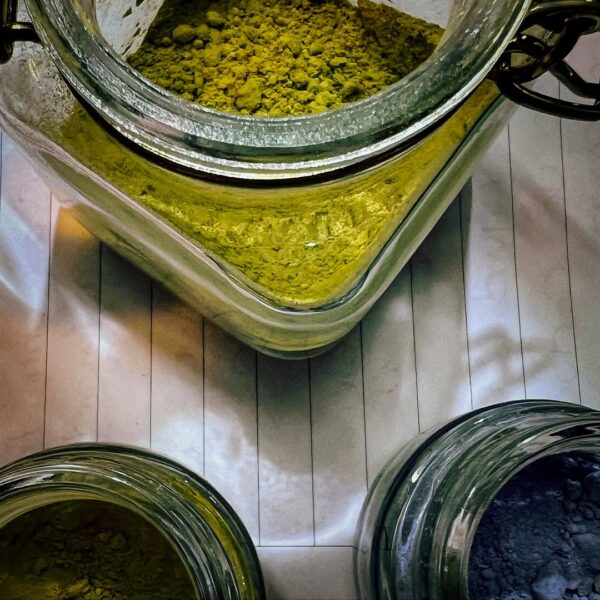


In the following table, I present a list of plants along with the colors that can be obtained using alum as a metallic salt. It is also possible to achieve different shades with certain plants by adding iron, copper sulfate, citric acid, etc. This list is not exhaustive!
| Plante | Nom latin | Partie utilisée | Couleur obtenue | Colorant | Visualisation |
|---|---|---|---|---|---|
| 🔵 Teintes bleues | |||||
| Baptisia | Baptisia tinctoria | Feuilles, tiges | Bleu indigo (pâle) | Indigoïdes | |
| Maurelle / Tournesol à drapeaux | Chrozophora tinctoria | Parties aériennes | Bleu-violet (tournesol) | Croconique (tricoccine) | |
| Indigotier | Indigofera tinctoria | Feuilles | Bleu indigo profond | Indigoïdes (indican) | |
| Laurier des teinturiers | Wrightia tinctoria | Feuilles | Bleu indigo | Indigoïdes | |
| Liane-indigo / Gara | Philenoptera cyanescens (= Lonchocarpus cyanescens) | Feuilles | Bleu indigo | Indigoïdes | |
| Marsdenia | Marsdenia tinctoria | Feuilles | Bleu indigo | Indigoïdes | |
| Pastel des teinturiers / Guède | Isatis tinctoria | Feuilles | Bleu indigo | Indigoïdes | |
| Renouée des teinturiers | Persicaria tinctoria (= Polygonum tinctorium) | Feuilles | Bleu indigo | Indigoïdes (indican) | |
| Indigo d’Assam | Strobilanthes cusia (= S. flaccidifolius) | Feuilles, tiges | Bleu indigo profond | Indigoïdes | |
| 🟤 Teintes brun à noir | |||||
| Acacia à cachou | Acacia catechu | Bois, aubier | Brun roux à noir | Tanins catéchiques (catéchine) | |
| Campêche | Haematoxylum campechianum | Bois du cœur | Noir bleuté / Violet-noir | Hématoxyline | |
| Henné | Lawsonia inermis | Feuilles séchées | Brun orangé à brun foncé | Lawsone (naphtoquinone) | |
| Noyer commun | Juglans regia | Coques vertes, feuilles | Brun foncé à noir | Juglone (naphtoquinone), tanins | |
| Sumac des corroyeurs | Rhus coriaria | Feuilles, fruits | Brun beige / Gris-brun | Tanins galliques | |
| Chêne | Quercus robur | Écorce, galle | Brun foncé | Tanins | |
| Aulne | Alnus glutinosa | Écorce, cônes | Brun moyen | Tanins | |
| Saule | Salix spp. | Écorce | Brun gris | Tanins | |
| 🟡 Teintes jaunes | |||||
| Camomille des teinturiers | Anthemis tinctoria | Capitules | Jaune clair | Flavonoïdes | |
| Chanvre bâtard | Galeopsis tetrahit | Parties aériennes | Jaune verdâtre | Flavonoïdes | |
| Chêne quercitron | Quercus velutina | Écorce intérieure | Jaune orangé vif | Quercitrine (flavonoïde) | |
| Clinopode commun | Clinopodium vulgare | Parties aériennes fleuries | Jaune paille | Flavonoïdes | |
| Curcuma | Curcuma longa | Rhizomes | Jaune vif à orangé | Curcumine | |
| Genêt des teinturiers | Genista tinctoria | Parties aériennes | Jaune doré | Flavonoïdes | |
| Oignon (pelures jaunes) | Allium cepa | Tuniques sèches | Jaune doré | Quercétine (flavonoïde) | |
| Gaude / Réséda des teinturiers | Reseda luteola | Parties aériennes | Jaune vif naturel | Lutéoline, apigénine (flavonoïdes) | |
| Rhubarbe | Rheum spp. | Racines | Jaune à jaune brun | Anthraquinones, tanins | |
| Safran | Crocus sativus | Stigmates | Jaune orangé lumineux | Crocine, crocétine (caroténoïdes) | |
| Sarrette des teinturiers | Serratula tinctoria | Parties aériennes | Jaune verdâtre | Flavonoïdes (lutéoline) | |
| Tanaisie commune | Tanacetum vulgare | Fleurs | Jaune vert | Flavonoïdes | |
| Tussilage | Tussilago farfara | Capitules, feuilles | Jaune pâle | Flavonoïdes | |
| Millepertuis | Hypericum perforatum | Sommités fleuries | Jaune doré | Naphthodianthrones | |
| Solidage (verge d’or) | Solidago virgaurea | Sommités fleuries | Jaune clair | Flavonoïdes | |
| Bouleau | Betula pendula | Feuilles, écorce | Jaune / Brun clair / Rose pâle | Flavonoïdes, tanins | |
| 🟠 Teintes oranges | |||||
| Cryptocarya | Cryptocarya rubra (= Cryptocarya alba) | Écorce | Orange rougeâtre | Tanins, pigments phénoliques | |
| Curcuma | Curcuma longa | Rhizomes | Orange vif | Curcumine | |
| Gaillet gratteron | Galium aparine | Racines | Rouge orangé | Anthraquinones | |
| 🔴 Teintes rouge à brun | |||||
| Aspérule des teinturiers | Asperula tinctoria | Racines | Rouge rosé | Anthraquinones | |
| Aspérule odorante | Galium odoratum | Racines | Rouge pâle | Anthraquinones | |
| Carthame des teinturiers | Carthamus tinctorius | Fleurs | Rouge carmin à orange | Carthamine, safflor jaune | |
| Coquelicot | Papaver rhoeas | Pétales | Rouge vif | Anthocyanes | |
| Fenugrec | Trigonella foenum-graecum | Graines | Brun jaunâtre à rouge brun | Flavonoïdes, tanins | |
| Garance du Sikkim | Rubia sikkimensis | Racines | Rouge profond | Anthraquinones | |
| Garance des teinturiers | Rubia tinctorum | Racines | Rose / Rouge profond / Carmin | Anthraquinones | |
| Garance voyageuse | Rubia peregrina | Racines | Rouge moyen | Anthraquinones | |
| Henné | Lawsonia inermis | Feuilles séchées | Rouge orangé à brun roux | Lawsone (naphtoquinone) | |
| Nerprun alaterne | Rhamnus alaternus | Baies, feuilles | Rouge à brun rouge | Anthracènes, flavonoïdes | |
| Noyer commun | Juglans regia | Coques, feuilles | Brun roux à brun rouge | Juglone, tanins | |
| Orcanette des teinturiers | Alkanna tinctoria | Racines | Rouge violet à pourpre | Alkanine, shikonine (naphtoquinones) | |
| Orcanette jaune | Alkanna lutea | Racines | Rouge-rose | Naphtoquinones | |
| Orseille | Roccella tinctoria | Thalle du lichen | Violet rouge / Pourpre | Acide orseillique (orcinol) | |
| Pernambouc (Brésillet) | Paubrasilia echinata | Bois du cœur | Rouge à rouge orangé | Braziléine, braziline | |
| Roucou (Rocou) | Bixa orellana | Graines (arille) | Rouge orangé vif | Bixine, norbixine (caroténoïdes) | |
| Sumac des corroyeurs | Rhus coriaria | Feuilles, fruits | Rouge brun / Brun beige | Tanins galliques | |
| 🟣 Teintes violettes | |||||
| Sureau noir | Sambucus nigra | Baies | Violet foncé | Anthocyanes | |
| Mûrier sauvage | Rubus fruticosus | Fruits | Violet moyen | Anthocyanes | |