


Home » 7th Continent
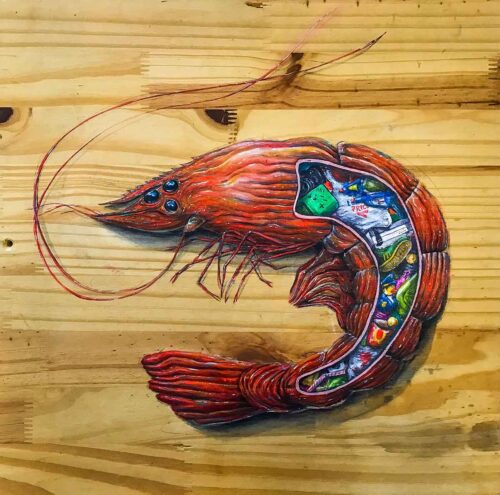
Acrylic and watercolor on wood – 46.4×53 cm – 2019
Plastic is everywhere, even where you least expect it. This scourge has become so uncontrollable that it is now found in virtually every organism on Earth as microplastics. This deeply depressing observation made me feel helpless in the face of this catastrophe.

The 7th continent is a gigantic accumulation of plastic waste floating in the middle of the oceans. A ‘wonder’ entirely created by us humans. This pollution has direct consequences for marine wildlife. Many animals ingest this waste, filling their stomachs with plastic instead of food, slowly condemning them.
The visible effects are terrifying: fish with bellies swollen from plastic pieces, turtles growing deformed after being caught in abandoned nets, and seabirds whose organs are pierced by sharp debris.
I decided to paint what these marine animals, victims of pollution, inspired in me.
The first work in the series depicted Flounder, Ariel the Little Mermaid’s faithful companion, whose body’s interior revealed an accumulation of plastic objects.
With its altered body, overrun with waste, my goal was to highlight this issue in my own way.

Acrylic on canvas – 100×100 cm – 2018

Acrylic and watercolor on wood – 40×70 cm – 2018

Acrylic on canvas – 195 x 195 cm – 2019
After Flounder, I told myself I wouldn’t stop at just one painting. I then painted Gary, SpongeBob’s pet snail. Then came Nemo, then Dory, then Franklin the turtle, then Mario Frog. And then came the questions…
Why talk about plastic pollution while painting with acrylics and synthetic pigments? Wasn’t I, ultimately, contributing more to the problem than I was calling it out?

Acrylic on canvas – 50×100 cm – 2019
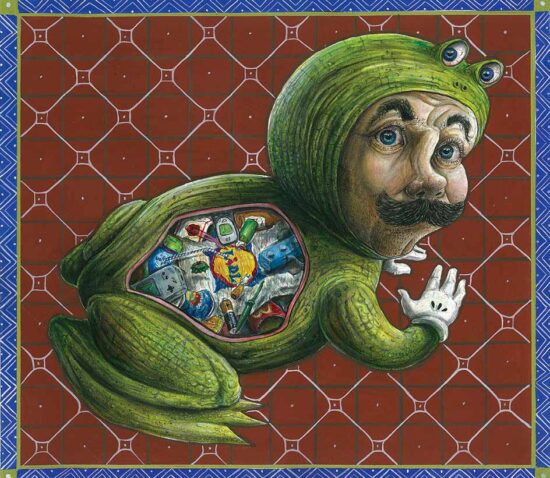
Watercolors on paper – 40×60 cm – 2021
To address this inconsistency, I decided to find solutions that would allow me to align with the values I wanted to convey through my work.
I undertook the creation of my own paints with the aim of better understanding and mastering their composition. During my research, I quickly discovered many alternatives to acrylic. I experimented with several recipes, including egg tempera, flour paint, and even homemade watercolor. As I became familiar with these new techniques, I integrated them into my new works.
Through my research and experiments, my knowledge of paint making deepened, allowing me to almost entirely do without acrylic. Gradually, my painting techniques became consistent with the message conveyed by my paintings.
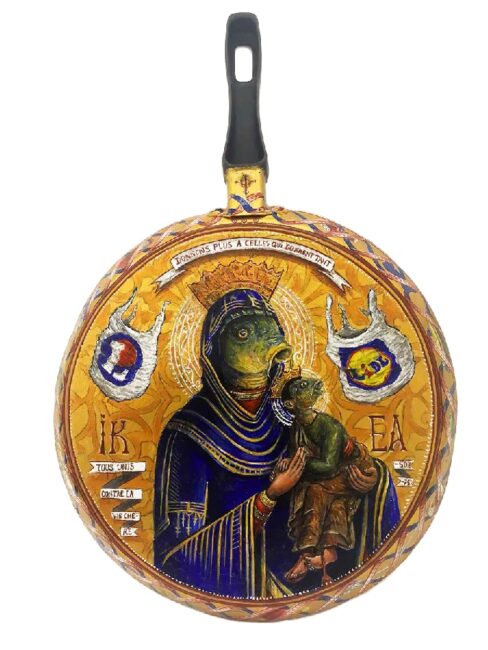
Tempera on frying pan – diameter 32 cm – 2020
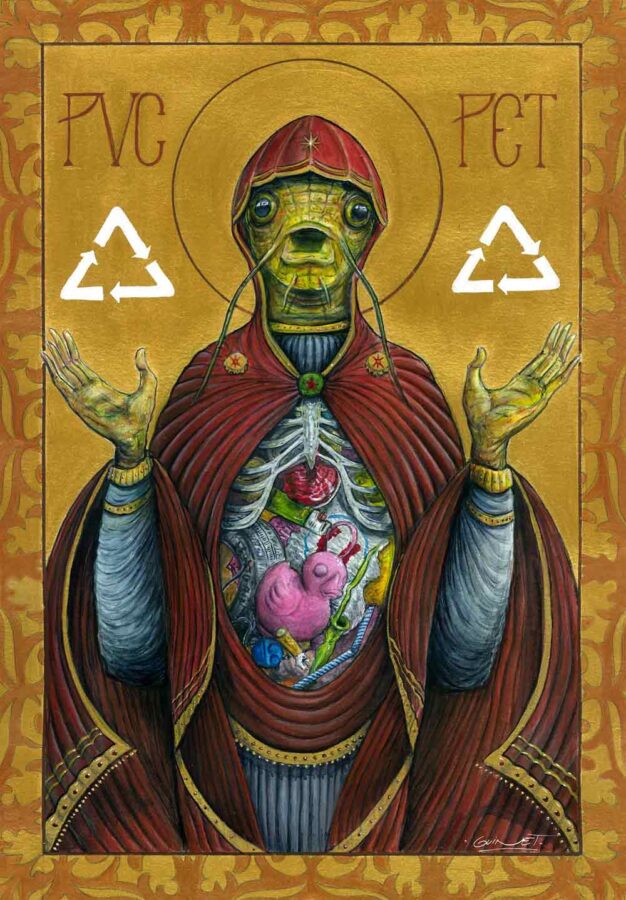
Tempera on paper
30 x 42 cm – 2021
Plastic pollution isn’t limited to the oceans: it has invaded every environment, all the way to the air we breathe and the water we drink. Some studies estimate that we ingest up to 5 g of plastic per week, in the form of microparticles. Researchers have even found it in our brains. So it made sense for me to evolve this series by including land animals too, also victims of this disaster that doesn’t seem close to stopping. If forecasts are to be believed, plastic production could triple by 2060!

Tempera on wood – 100×100 cm – 2021

Flour paint on concrete – 2021