



Of all the ways to make your own watercolors that you can find in books and online, there’s one that comes up very often. It’s the recipe I call the “classic” one. The vast majority of makers who create their own watercolors use it.
The binder for this recipe keeps for a long time in a clean container, which means you don’t have to prepare all your watercolors at once.


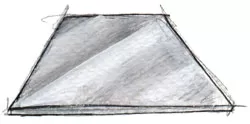
If you don't have one, you can use a palette knife.
Note: The products marked with the “🛒” symbol are affiliate links. If you purchase through these links, I receive a small commission that helps support this blog, at no extra cost to you.
If you don't have pans, no worries. Use an ice cube tray! Some artists use acorn caps, others use seashells. The most important thing is to use something that won't rust. Otherwise, your watercolors could become dull, or even unusable.

The first part of this recipe is to make the binder, which is the essential element of any paint. Without binder, the paint can’t stick to the surface.
It is very important that all the materials you use in this recipe are clean to prevent mold from forming.
In this recipe we will prepare 100 g of binder. You will need:
If you have liquid gum arabic, you can move on to step 2.
If you have gum arabic in granules (or crystals) or powder form, you need to prepare gum water.
Your binder is ready!
To fill a half pan, you’ll need about 8 g of pigment, roughly the equivalent of a teaspoon, to mix with 8 g of binder.

Continue until you no longer hear the pigment “squeak.” The more time you spend on this step, the finer your watercolor will be.
Some makers fill the pans 5 or 6 times to prevent cracking.
And there you go—you now know the recipe for making your own watercolors!