

Home » Directory of Dye Plants
Before you begin, it’s important to know what a dye plant is.
All plants can produce colour, but only some are truly considered dye plants.
These are plants whose certain parts (roots, leaves, flowers, bark, etc.) can be used to make dyes or colorants.
Traditionally, they are mainly used to colour natural textile fibres such as wool, cotton, or silk. But they are also found in food or body colorants, for example for makeup or certain ritual paints. They can also be transformed into pigments for making paints (they are then called lake pigments).
Dyeing and lake pigment making are closely related, as they both use soluble coloring substances extracted from plants or insects.
For those who wish to make their own paints, it is essential to understand how dyers obtain their colors, as these are precisely the shades we aim to transform into pigments.
In textile dyeing, the dye fixes directly onto natural fibers — wool, cotton, or silk — through specific chemical interactions.
The production of lake pigments is based on a similar principle, but the main difference lies in the support used: instead of a fabric, the dye is precipitated onto an inert support. This step transforms the soluble dye into a stable and insoluble pigment, which can then be ground and mixed with a binder to produce paint.
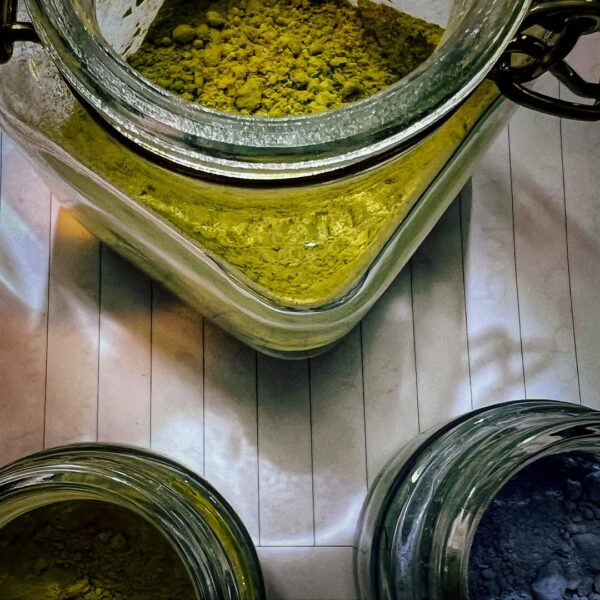


In the following table, I present a list of plants and the colors that can be obtained using alum as a metallic salt. It is also possible to achieve different shades with certain plants by adding iron, copper sulfate, citric acid, etc. This list is not exhaustive!
| Plant | Latin name | Part used | Resulting color | Dye compound | Color swatch |
|---|---|---|---|---|---|
| 🔵 Blue shades | |||||
| Baptisia (wild indigo) | Baptisia tinctoria | Leaves, stems | Indigo blue (pale) | Indigoids | |
| Turnsole / Dyer’s croton | Chrozophora tinctoria | Aerial parts | Blue-violet (turnsole) | Croconic (tricoccin) | |
| True indigo | Indigofera tinctoria | Leaves | Deep indigo blue | Indigoids (indican) | |
| Indigo vine / Gara | Philenoptera cyanescens (= Lonchocarpus cyanescens) | Leaves | Indigo blue | Indigoids | |
| Marsdenia | Marsdenia tinctoria | Leaves | Indigo blue | Indigoids | |
| Woad | Isatis tinctoria | Leaves | Indigo blue | Indigoids | |
| Japanese indigo (dyer’s knotweed) | Persicaria tinctoria (= Polygonum tinctorium) | Leaves | Indigo blue | Indigoids (indican) | |
| Assam indigo | Strobilanthes cusia (= S. flaccidifolius) | Leaves, stems | Deep indigo blue | Indigoids | |
| 🟤 Brown to black shades | |||||
| Catechu acacia (cutch tree) | Acacia catechu | Wood, sapwood | Reddish brown to black | Catechin tannins (catechin) | |
| Logwood | Haematoxylum campechianum | Heartwood | Bluish black / Violet-black | Hematoxylin | |
| Henna | Lawsonia inermis | Dried leaves | Orange-brown to dark brown | Lawsone (naphthoquinone) | |
| Common walnut | Juglans regia | Green husks, leaves | Dark brown to black | Juglone (naphthoquinone), tannins | |
| Tanner’s sumac | Rhus coriaria | Leaves, fruits | Beige-brown / Grey-brown | Gallic tannins | |
| Oak | Quercus robur | Bark, galls | Dark brown | Tannins | |
| Alder | Alnus glutinosa | Bark, cones | Medium brown | Tannins | |
| Willow | Salix spp. | Bark | Grey-brown | Tannins | |
| 🟡 Yellow shades | |||||
| Dyer’s chamomile | Anthemis tinctoria | Flower heads | Light yellow | Flavonoids | |
| Common hemp-nettle | Galeopsis tetrahit | Aerial parts | Greenish yellow | Flavonoids | |
| Quercitron oak (black oak) | Quercus velutina | Inner bark | Bright orange-yellow | Quercitrin (flavonoid) | |
| Wild basil | Clinopodium vulgare | Flowering aerial parts | Straw yellow | Flavonoids | |
| Turmeric | Curcuma longa | Rhizomes | Bright yellow to orange | Curcumin | |
| Dyer’s greenweed | Genista tinctoria | Aerial parts | Golden yellow | Flavonoids | |
| Onion (yellow skins) | Allium cepa | Dry outer skins | Golden yellow | Quercetin (flavonoid) | |
| Weld / Dyer’s rocket | Reseda luteola | Aerial parts | Natural bright yellow | Luteolin, apigenin (flavonoids) | |
| Rhubarb | Rheum spp. | Roots | Yellow to brownish yellow | Anthraquinones, tannins | |
| Saffron | Crocus sativus | Stigmas | Luminous orange-yellow | Crocin, crocetin (carotenoids) | |
| Dyer’s saw-wort | Serratula tinctoria | Aerial parts | Greenish yellow | Flavonoids (luteolin) | |
| Common tansy | Tanacetum vulgare | Flowers | Yellow-green | Flavonoids | |
| Coltsfoot | Tussilago farfara | Flower heads, leaves | Pale yellow | Flavonoids | |
| St John’s wort | Hypericum perforatum | Flowering tops | Golden yellow | Naphthodianthrones | |
| Goldenrod | Solidago virgaurea | Flowering tops | Light yellow | Flavonoids | |
| Silver birch | Betula pendula | Leaves, bark | Yellow / Light brown / Pale pink | Flavonoids, tannins | |
| 🟠 Orange shades | |||||
| Cryptocarya (peumo) | Cryptocarya rubra (= Cryptocarya alba) | Bark | Reddish orange | Tannins, phenolic pigments | |
| Turmeric | Curcuma longa | Rhizomes | Bright orange | Curcumin | |
| Cleavers (goosegrass) | Galium aparine | Roots | Orange-red | Anthraquinones | |
| 🔴 Red to brown shades | |||||
| Dyer’s woodruff | Asperula tinctoria | Roots | Pinkish red | Anthraquinones | |
| Sweet woodruff | Galium odoratum | Roots | Pale red | Anthraquinones | |
| Safflower | Carthamus tinctorius | Flowers | Carmine red to orange | Carthamin, safflower yellow | |
| Corn poppy | Papaver rhoeas | Petals | Bright red | Anthocyanins | |
| Fenugreek | Trigonella foenum-graecum | Seeds | Yellowish brown to reddish brown | Flavonoids, tannins | |
| Common madder | Rubia tinctorum | Roots | Pink / Deep red / Carmine | Anthraquinones | |
| Wild madder | Rubia peregrina | Roots | Medium red | Anthraquinones | |
| Henna | Lawsonia inermis | Dried leaves | Orange-red to reddish brown | Lawsone (naphthoquinone) | |
| Mediterranean buckthorn | Rhamnus alaternus | Berries, leaves | Red to reddish brown | Anthracenes, flavonoids | |
| Common walnut | Juglans regia | Husks, leaves | Rust brown to red-brown | Juglone, tannins | |
| Dyer’s alkanet | Alkanna tinctoria | Roots | Violet-red to purple | Alkannin, shikonin (naphthoquinones) | |
| Yellow alkanet | Alkanna lutea | Roots | Pink-red | Naphthoquinones | |
| Orchil (archil) | Roccella tinctoria | Lichen thallus | Reddish violet / Purple | Orsellinic acid (orcinol) | |
| Pernambuco (brazilwood) | Paubrasilia echinata | Heartwood | Red to orange-red | Brazilein, brazilin | |
| Annatto | Bixa orellana | Seeds (aril) | Bright orange-red | Bixin, norbixin (carotenoids) | |
| Tanner’s sumac | Rhus coriaria | Leaves, fruits | Red-brown / Beige-brown | Gallic tannins | |
| 🟣 Violet shades | |||||
| Black elder | Sambucus nigra | Berries | Dark violet | Anthocyanins | |
| Wild blackberry (bramble) | Rubus fruticosus | Fruits | Medium violet | Anthocyanins | |